



Petroleum Bitumen
Petroleum or distilled bitumen is obtained from the refining of crude oil. This bitumen is the product of two stages of crude oil distillation in a distillation tower. In the first stage, due to heat, light materials such as gasoline, oil, etc., are separated from the oil. This process occurs at a pressure close to one atmosphere. In the second stage, which is carried out at a pressure close to a vacuum, heavy compounds such as diesel and kerosene are removed, and finally, a mixture of very fine solid particles called asphalt remains, which is immersed in malten (a greasy fluid material). This material is used as feedstock for bitumen production units. It is worth mentioning that the products obtained from crude oil refining include the following:
- Light Gasoline
- Naphta
- Kerosene
- Gasoil
- Fuel Oil
- Solid Bitumen
Therefore, as mentioned, petroleum bitumen is produced from the refining of crude oil at high temperatures and in a short time. Moreover, excessive heating causes excessive evaporation of its mineral oils and reduces the bitumen’s adhesiveness.
Natural Bitumen
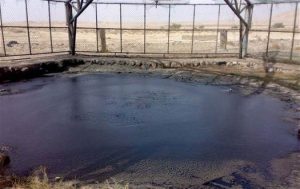
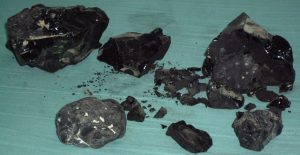
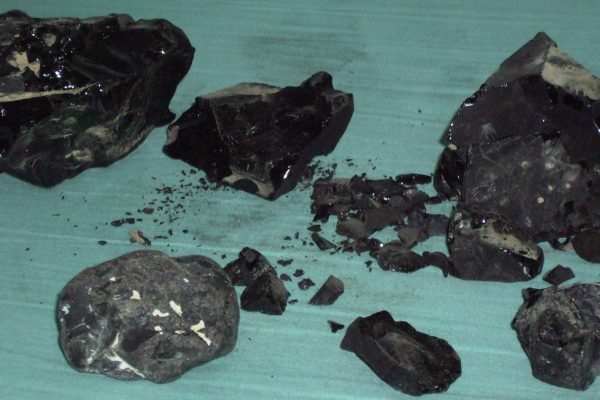
Some types of bitumen are obtained from the gradual conversion of crude oil and the evaporation of its volatile materials over many years, which is called natural bitumen and is known as uintaite. It is more durable than petroleum bitumen. This bitumen is also called lake bitumen, and examples include the Behbehan bitumen lake in Iran and the Trinidad Lake asphalt in America.
Blown Bitumen
To make petroleum bitumen with a high softening point have elasticity even in cold weather, air is blown into it to oxidize. Blowing hot air into pure bitumen in the final stage of the refining process results in blown bitumen (Rubbery Grade). In this process, hot air with a temperature of 200 to 300 degrees Celsius is blown into a chamber containing bitumen through perforated pipes. As a result of this process, the hydrogen atoms present in the hydrocarbon molecules of bitumen combine with the oxygen in the air, forming water, and polymerization occurs, resulting in a bitumen with properties similar to mineral bitumen.
Blown bitumen has advantages over pure bitumen, which are mentioned below:
- It has a lower penetration grade compared to pure bitumen.
- The softening point of blown bitumen is higher than that of the initial pure bitumen because its oils do not separate.
- Blown bitumen is less sensitive to temperature changes and, therefore, retains its hardness at higher temperatures much better than pure bitumen.
This type of bitumen is mainly used for making roofing sheets, batteries, and sealing under cars, coating pipes, and making bitumen-coated cardboard and sacks. The abbreviation for blown bitumen is R, for example, 80/25 R bitumen means blown bitumen with a softening point of 80 and a penetration grade of 25.
Cutback Bitumen
Cutback bitumen is obtained by dissolving pure bitumen in a suitable solvent such as gasoline, kerosene, or diesel. This bitumen is liquid at ambient temperature and becomes liquid with a little heat. However, the type and properties of cutback bitumen depend on the type and ratio of the material used as a solvent. The higher the amount of petroleum material in the cutback bitumen, the more fluid it is and, consequently, the lower its viscosity. However, the setting time or hardening of this type of bitumen depends on the type of solvent, so if gasoline is used to dissolve pure bitumen, due to the high evaporation rate of gasoline, the bitumen dissolved in gasoline hardens faster, which is called rapidly curing bitumen or RC for short because after the bitumen is consumed, the gasoline in it evaporates quickly and pure bitumen remains. Also, if kerosene is used as a solvent for bitumen, due to the slow evaporation of kerosene compared to gasoline, the solution is called medium curing or MC for short, and whenever diesel or heavier products such as gas oil or fuel oil are used as a solvent for bitumen, it is called slow curing or SC for short.
The features of cutback bitumen include:
- No need for heating equipment when using bitumen
- Decomposition of bitumen at high temperatures
- Cooling of bitumen during work
- Suitable penetration into porous minerals
- Reducing the time of operation during consumption
This bitumen is used in various surface and macadam asphalts. Also, this type of bitumen is classified based on its viscosity grade.
Emulsified Bitumen
An emulsion is a two-phase mixture of two immiscible liquids in which the internal phase is finely dispersed within the external phase. The particle size in the emulsion is between 0.1 and 5 microns. Normally and without the use of an emulsifier (emulsifying agent), this suspension is not stable, and the two immiscible liquids quickly separate from each other and form two distinct phases. For this reason, by adding a substance called an emulsifier, which is usually an alkali salt of organic acids or an ammonium salt, and creating suitable conditions, the suspension of particles becomes stable, and a stable emulsion is formed. Therefore, emulsified bitumen is obtained by mixing bitumen, water, and an emulsifier. The amount of emulsifier is very small and is about 0.3 to 0.5% of the weight of the bitumen, and the amount of water used in this type of bitumen is about 30 to 50% of the weight of the bitumen. Adding the emulsifier to this mixture causes the bitumen particles to become charged, thus causing the bitumen particles to repel each other due to electrostatic repulsion and float in the water as spheres with a diameter of 0.01 to 0.001 mm, which produces a bitumen called emulsified bitumen. The use of this type of bitumen reduces environmental pollution and, since it does not use oil or flammable solvents in its production, the risk of ignition during transportation is reduced. Emulsified bitumen is used for cold asphalt in humid environments or for waterproofing, in which case water must be added to it again and its water content increased to 65%.